
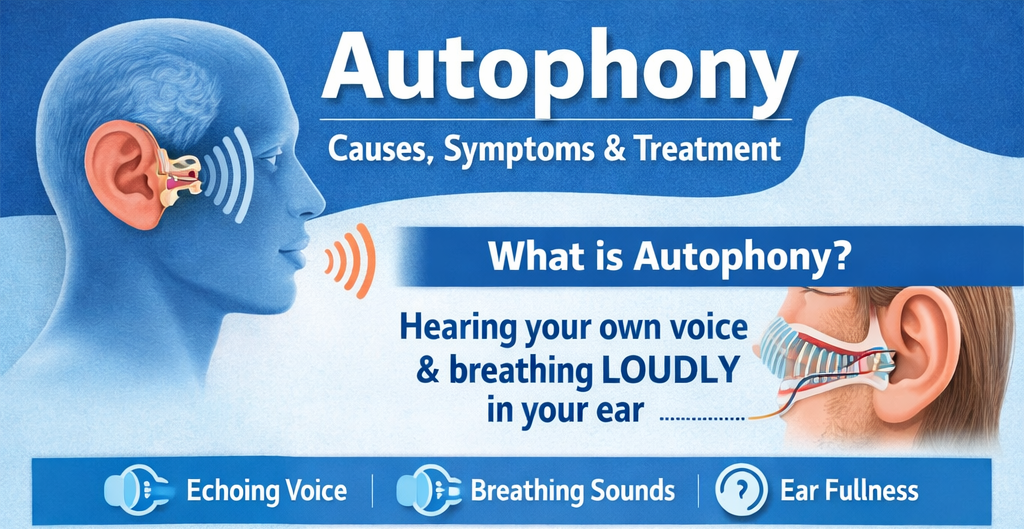
Autophony is a hearing condition where a person hears their own voice, breathing, or body sounds unusually loud inside their ear. People with autophony often describe the sensation as if their voice is echoing or booming inside their head. It can be uncomfortable and sometimes disturbing.
Normally, our ears regulate internal sounds so we don’t notice them much. But when autophony occurs, the ear’s sound system becomes disrupted, making internal sounds much louder than normal.
Autophony is not a disease itself but a symptom of an underlying ear condition.
Common Symptoms of Autophony
People experiencing autophony may notice the following symptoms:
- Hearing their own voice very loudly
- Hearing breathing sounds inside the ear
- Feeling like the ear is blocked
- Echoing sound when speaking
- Hearing heartbeat or chewing sounds
- Discomfort while talking
- Symptoms sometimes improve when lying down or lowering the head
These symptoms can affect daily communication and concentration.

Main Causes of Autophony
Several ear conditions can cause autophony. The most common ones include:
1. Patulous Eustachian Tube (PET)
This is the most common cause of autophony.
The Eustachian tube connects the middle ear to the throat and normally stays closed. In Patulous Eustachian Tube, the tube remains abnormally open, allowing sound vibrations from breathing and speech to travel directly into the ear.
Symptoms often include:
- Hearing breathing loudly
- Ear fullness
- Voice echo
2. Superior Semicircular Canal Dehiscence (SSCD)
This condition occurs when there is a small hole in the bone covering the inner ear balance canal. Because of this opening, internal sounds become amplified.
People with SSCD may experience:
- Loud internal sounds
- Balance problems
- Sensitivity to loud noises
- Hearing eye movements or footsteps
3. Middle Ear Problems
Conditions affecting the middle ear can also cause autophony, such as:
- Fluid in the middle ear
- Ear infections
- Tympanic membrane abnormalities
These problems change how sound travels through the ear.
4. Sudden Weight Loss
Rapid weight loss can reduce the fatty tissues around the Eustachian tube, making it stay open and causing autophony.
How Autophony is Diagnosed
An ENT specialist or audiologist performs several tests to diagnose the cause of autophony.
Common diagnostic tests include:
1. Hearing Test (Audiometry)
This test checks overall hearing ability and detects abnormalities.
2. Tympanometry
This evaluates the movement of the eardrum and middle ear pressure.
3. CT Scan
A high-resolution CT scan of the temporal bone can detect conditions like SSCD.
4. Nasal Endoscopy
Doctors may check the Eustachian tube opening through the nose.
Proper diagnosis is essential because treatment depends on the underlying cause.
Treatment Options for Autophony
Treatment depends on the cause and severity of symptoms.
1. Hydration and Lifestyle Changes
For mild cases, doctors may recommend:
- Drinking more fluids
- Avoiding decongestants
- Gaining healthy weight if underweight
2. Nasal Drops or Medication
Certain nasal medications can help reduce Eustachian tube opening.
3. Eustachian Tube Treatments
For Patulous Eustachian Tube, treatments may include:
- Eustachian tube injections
- Surgical procedures to narrow the tube
4. Surgery
If the cause is Superior Semicircular Canal Dehiscence, surgery may be required to repair the bone defect.
When to See a Hearing Specialist
You should consult a hearing specialist if you experience:
- Persistent echoing of your voice
- Hearing breathing loudly in the ear
- Sudden hearing changes
- Ear fullness lasting more than a few days
Early diagnosis can prevent complications and improve quality of life.
Prevention Tips
Although autophony cannot always be prevented, the following steps may reduce the risk:
- Avoid excessive use of nasal decongestants
- Maintain healthy body weight
- Protect ears from infections
- Seek treatment for ear problems early


